
The technology used in the Milpitas PRT project was developed over decades by scores of people working to create a system that satisfies a list of performance criteria. While the design is detailed in theITNS Business Plan, most people are satisfied learning about the high-level aspects of PRT capacity, cost and hardware.
Find a clear overview of public transit metrics and trends of service provided/consumed in the United States atNational Transit Summaries and Trends(NTST).
Self-Conflicted Public Transit
Considered how self-conflicted conventional public transit is. It keeps getting in its own way.
- Adding stations to increase access adds stops, which slows down service• Increasing capacity with larger vehicles requires bigger, more expensive infrastructure
- Bigger infrastructure is best laid out along large corridors
- Passengers must first get to the corridor, then await and ride the next vehicle, then get to their ultimate destination• Adding a new line adds a transfer. Passengers hate waiting during transfers.
Automated transit networks (ATN) avoid these conflicts in the following ways.
- Move all stations onto sidings, so through traffic bypasses them at speed.
- Use many small vehicles traveling close together (like cars, not widely-spaced buses). Smaller vehicles require smaller infrastructure that costs less and fits into more places
- Use smaller infrastructure: small, interconnected one-way loops spread throughout the community – not just along corridors.
- Reduce stops: Small vehicles on small loops travel from origin to destination with little or no intermediate stopping. Small loops minimize out-of-the-way travel.
- Create a network of interconnected loops. They can be infinitely expanded with no need for transfers.
ATN does not suffer from self-conflicts and can thus provide quick, reliable service throughout the community with good capacity and low cost.
Capacity
Due to experiences with mass transit systems, some people question the ability of PRT’s small vehicles to move significant numbers of people. They overlook our dominant transportation option, the automobile, that uses small vehicles to transport most of us most of the time. So, a better question is: Can PRT deliver satisfactory service using a few guideways spaced roughly 1/2 mile apart?Click hereto see how a single guideway can transport as many people as multiple lanes of freeway.
Cost
Mass transit systems have also conditioned people to expect high price tags for building and operating public transit infrastructure. People familiar with the cost of building at-grade Light Rail Transit (LRT) and BART ($60M/mile and $230M/mile respectively) would naturally question the $30M/mile cost of elevated PRT guideways. Likewise, the goal of providing free service is also questioned.Click hereto learn why PRT is relatively inexpensive to build and operate.
Hardware
Engineers and gadgeteers are likely more interested in the hardware aspects of the PRT system proposed for Milpitas.Click hereto get those details.
“… changing your mind is one of the best ways of finding out whether or not you still have one.” ― Taylor Mali
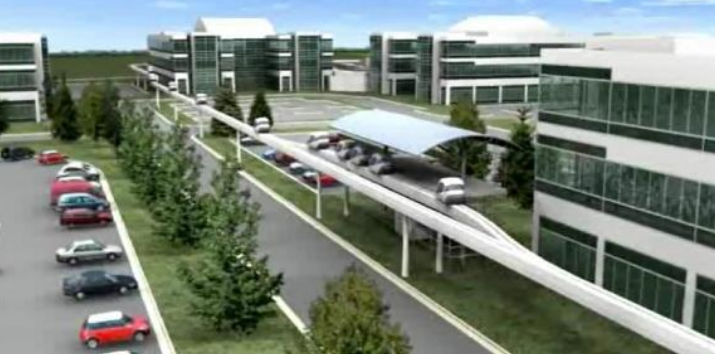
Videos that Introduce PRT Concepts
- 3-minute YouTube video introduction to PRT system (or a version that’s not on YouTube)
- 2-minute review of ATN Systems 1975 to 2023
- Deeper introduction to PRT technology
- 5-minute look at the existing Heathrow Airport (ULTra) PRT system
- 3-minute overview of Autotren (Modutram) PRT system being developed in Mexico
- 15-minute video of Santa Cruz PRT plans and existing systems worldwide
- 17-minute video of 1970’s PRT-like system at Morgantown, West Virginia
- Bubbles & Beams – 4-minute vision of a possible future traffic system, that makes it easy for anyone to travel.
- Glydways – Always Moving (30 seconds)
- 4-minute tourist experience of the Skycube at Suncheon Bay!
- 10-minute intro to Google spin-off Swyft Cities PRT project.
- 30-minute Glydways presentation to Santa Cruz County Regional Transportation Commission (March 7, 2024)